In a previous article I compared the performance of a commercially available LLM to non commercial LLMs in a language identification task using data obtained from tanzil.net (see here). I discovered that: 1. nomic-embed-text:latest and nomic-embed-text-v2-moe:latest achieved comparable performance to gemini-embedding-001 in identifying the language of the quranic text analysed; 2. suprisingly the performance of nomic-embed-text:latest which was developed primarily for the English language (en) was comparable (if not better) to both nomic-embed-text-v2-moe:latest and quran-embedding-prefect-gemini-embedding-001 which are multilingual; 3. a heuristic that uses the count of characters associated with the languages in the text, e.g Ge’ez for Amharic and alfabesi for Turkish, achieved comparable performance to gemini-embedding-001, nomic-embed-text-v2-moe:latest, and nomic-embed-text:latest.
The script used for each text is specific to the language of the text e.g. Arabic script for Arabic and Ge’ez for Amharic and this is instrumental to the success of the heurictic. This raised the following question: Which of the LLMs best captures the semantics of the words - so called word sense? This is aimed at looking beyond the characters in the text
Key Findings
gemini-embedding-001 captures meaning best. It has the highest mean precision@k (k=10) and mean reciprocal rank (MRR). Most of its hits are in other languages, so it matches a verse to its translations regardless of language or script.
nomic-embed-text-v2-moe:latest comes second overall and it beats Gemini on Bosnian and Albanian, and achieves comparable performance on Spanish and Turkish but performs poorly on Tajik (0.002), Divehi (0.000), Uzbek (0.007), Amharic (0.026), Sindhi (0.042) and Arabic (0.073), even though most of these are listed as supported.
nomic-embed-text:latest does not capture meaning across languages at all. Its cross-language precision@10 and cross-language MRR are both about 0.001 or below. Nearly all of its hits come from English queries finding another English translation (precision@10 of 0.694 for English, about 0 for most other languages).
All three models do poorly on Hausa and Somali which are low resource languages.
Caveats: - The nomic models were run without their recommended task prefixes (search_document: / search_query:), which may understate their performance.
So What 1. No free lunch: The evidence suggests Gemini best captures the semantics of the quran text because compared to other LLMs it reliably finds the same verse across languages, for example an Arabic verse from an English query. nomic-embed-text-v2-moe:latest is a viable alternative only for English and some Latin-script European languages, such as Bosnian, Albanian, Spanish and Turkish. For Arabic, Persian, Urdu and the Central Asian and South Asian languages, it falls well short of Gemini. 3. It is more than text deep: The earlier success of nomic-embed-text:latest in language identification is likely due to its sensitivity to language and script, not an understanding of meaning. 4. horses for courses: The best model for telling languages apart is not the best for matching meaning. For language identification, the simple character-count heuristic remains a viable option. 5. To draw the short straw: Users querying in low-resource languages such as Hausa and Somali would currently get poor results from any of these models. This is an area of research currently being covered by initiatives such as HausaNLP for Hausa, and SomaliNLP for somali.
To answer this question, I took the following approach:
Source Data: Each verse of the Quran, in a range of languages and translations from tanzil.net, was embedded with three models: gemini-embedding-001, nomic-embed-text:latest and nomic-embed-text-v2-moe:latest. The embeddings for each model are stored in their own collection on qdrant, alongside the verse text and its attributes (language, translator, chapter and verse). Details of the data and the models are given in Section 2.0.
Test Sample: I drew a random 40% sample of records (99,777) from the gemini-embedding-001 collection and downsampled English, which otherwise makes up about 42% of the data, to the average size of the other languages. This left 60,312 records. I then fetched exactly the same records from the two nomic collections, so the three samples are identical and only the embeddings differ between them.
Expectation: A verse means the same thing in every translation. For example, chapter 1, verse 1 in English (Hilali translation) has the same meaning as chapter 1, verse 1 in Arabic (Jalalayn). A model that captures meaning should therefore place the translations of a verse close together, regardless of their language or script.
Measurement: For each sample verse, I retrieved its 20 nearest neighbours from the full collection of that model. A neighbour counts as a hit if it is the same chapter and verse from a different translation. Each hit is also labelled as same-language (e.g. another English translation) or cross-language (e.g. the Arabic). I compared the models using two rank-based metrics, described in Section 3.1:
precision@k, the proportion of the top k neighbours that are hits, which rewards finding many translations of a verse (see here);
mean reciprocal rank (MRR), based on the rank of the first hit, which rewards finding one translation quickly (see here).
Cross-language hits are the key evidence: a model that only distinguishes languages can find other translations in the same language, but only a model that captures meaning can find the same verse in another language.
flowchart TD
    A[("Three Qdrant collections<br/>one per embedding model")] -->|"random 40% sample from the Gemini collection,<br/>English downsampled"| B["60,312 sample records"]
    B -->|"same records fetched from<br/>both nomic collections"| C["Identical samples,<br/>one set of vectors per model"]
    C -->|"top-20 nearest neighbours per verse,<br/>query record excluded"| D["Nearest neighbours"]
    D -->|"hit = same chapter and verse,<br/>different translation"| E["Same-language and<br/>cross-language hits"]
    E --> F["Precision@k<br/>k = 1, 5, 10, 20"]
    E --> G["MRR@20"]
    F --> H["Model comparison,<br/>overall and by language"]
    G --> H
2.0 Data
The vectorised quranic text obtained from tanzil.net is stored in the following collections on a qdrant instance running locally on a homelab cluster. Details of each collection and the vectorisers used is provided below:
A list of the languages covered in this study and whether or not they are supported by either of the embedding models is provided below
Code
Language
gemini-embedding-001
nomic v1.5 (nomic-embed-text-latest)
nomic-embed-text-v2-moe
am
Amharic
✓
✗
✓
ar
Arabic
✓
✗
✓
bs
Bosnian
✓
✗
✓
dv
Divehi
✓
✗
✗
en
English
✓
✓
✓
es
Spanish
✓
✗
✓
fa
Persian
✓
✗
✓
ha
Hausa
✓
✗
✓
nl
Dutch
✓
✗
✓
ru
Russian
✓
✗
✓
sd
Sindhi
✓
✗
✗
so
Somali
✓
✗
✓
sq
Albanian
✓
✗
✓
ta
Tamil
✓
✗
✓
tg
Tajik
✓
✗
✓
th
Thai
✓
✗
✓
tr
Turkish
✓
✗
✓
ur
Urdu
✓
✗
✓
uz
Uzbek
✓
✗
✓
zh
Chinese
✓
✗
✓
2.1 Sampling
Samples were collected from the collections starting with one collection first and then using the text in the first collection to sample records matching the same text from the other two collections.
The data is largely comprised of text in English (en) therefore some downsampling was applied to prevent skewing the results.
Code
def downsample_majority(df,samp_col="language",random_state=1235813): props = df.groupby([samp_col]).size().to_dict() sorted_props =sorted(props, key=lambda e:props[e],reverse=True) maj = sorted_props[0] avg_minority =int(np.ceil(np.mean([props[e] for e in props if e!=maj]))) A = df[df[samp_col].eq(maj)].sample(avg_minority, random_state=random_state) B = df[~df[samp_col].eq(maj)] C = pd.concat([A,B]).reset_index(drop=True)return C
The table below shows how many records the 40% sample drew from each language. English makes up 42,337 of the 99,777 records (about 42%), because the collection holds far more English translations than translations in any other language. The first row (blank language code) counts records with no language code.
Code
freq = main_df.groupby(['language','language_description'],dropna=False).size()freq = pd.DataFrame(freq).rename(columns={0:"Number of Occurrences"})freq
vectors = {}# downsample_majority reorders rows, so index vectors by id to keep vectors[init][i] aligned with samples[init].iloc[i]idx = pd.Index(main_df['id']).get_indexer(samples[init]['id'])vectors[init] = vectors_main[idx]
The first five rows of the gemini-embedding-001 sample are shown below. Each row is one record: a verse, or part of a long verse, from one translation. text is the text that was embedded. language, name (the translator), chapter and verse identify it, and the revelation_* columns give the revelation metadata of its chapter (surah). The index column is the record’s position in the full collection before sampling.
Code
samples[init].head()
index
id
language
name
chapter
verse
text
surah_name
revelation_order
revelation_type
revelation_note
language_description
0
236019
f2627bd6-f23a-54e5-a1a6-5bbdbad95756
en
ahmedraza
88
7
Which neither give strength nor satisfy the hu...
Al-Ghaashiya
68
Meccan
NaN
English
1
248871
ff6d1d6b-bf5d-52c7-962a-966cc590144a
en
qarai
68
26
But when they saw it, they said, ‘We have inde...
Al-Qalam
2
Medinan
Except 17-33 and 48-50, from Medina
English
2
217314
df0c4ee7-8643-57f8-86ad-e5c489867bed
en
sahih
10
77
Moses said, "Do you say [thus] about the truth...
Yunus
51
Meccan
Except 40, 94, 95, 96, from Medina
English
3
4029
042bb1ea-609d-5059-bacc-dd2fe3110639
en
qaribullah
37
63
We have made this (tree) a trial for the evild...
As-Saaffaat
56
Meccan
NaN
English
4
24268
18e67fb4-1203-54f0-bf46-d011a8464c28
en
sahih
6
95
Indeed, Allah is the cleaver of grain and date...
Al-An'aam
55
Meccan
Except 20, 23, 91, 93, 114, 151, 152, 153, fro...
English
A sample equivalent to that collected from quran-embedding-prefect-gemini-embedding-001 was collected from the other two collections detailed in Section 2.0
Code
filter_columns = ['language','name','chapter','verse','text']colls = [coll for coll in collections if coll !=init]for c in colls:if collections[c]!=None:print("Processing {}".format(c)) matching_records = fetch_records_for_dataframe( samples[init], collections[c], filter_cols = filter_columns, batch_size =200, with_vectors =True ) samp, vec = extract_payload(matching_records, exclude=[]) samples[c] = pd.DataFrame(samp) vectors[c] = vecassertlen(samples[c]) ==len(samples[init]), (f"{c}: expected {len(samples[init])} matching records, got {len(samples[c])} ""- some rows had no exact match, so the like-for-like comparison ""across collections no longer holds." )assert (samples[c]['id'].to_numpy() == samples[init]['id'].to_numpy()).all(), (f"{c}: records are not in the same order as {init}, so vectors[{c!r}][i] ""would not correspond to samples[init].iloc[i]." )else: samples[c] =None vectors[c] =None
The first five rows of the matching nomic-embed-text:latest sample are shown below. They are the same records as in the gemini-embedding-001 table above, in the same order, with the same id, language, translator, chapter, verse and text. Only the stored embeddings differ.
Code
samples['nomic-embed-text:latest'].head()
id
language
name
chapter
verse
text
surah_name
revelation_order
revelation_type
revelation_note
0
f2627bd6-f23a-54e5-a1a6-5bbdbad95756
en
ahmedraza
88
7
Which neither give strength nor satisfy the hu...
Al-Ghaashiya
68
Meccan
NaN
1
ff6d1d6b-bf5d-52c7-962a-966cc590144a
en
qarai
68
26
But when they saw it, they said, ‘We have inde...
Al-Qalam
2
Medinan
Except 17-33 and 48-50, from Medina
2
df0c4ee7-8643-57f8-86ad-e5c489867bed
en
sahih
10
77
Moses said, "Do you say [thus] about the truth...
Yunus
51
Meccan
Except 40, 94, 95, 96, from Medina
3
042bb1ea-609d-5059-bacc-dd2fe3110639
en
qaribullah
37
63
We have made this (tree) a trial for the evild...
As-Saaffaat
56
Meccan
NaN
4
18e67fb4-1203-54f0-bf46-d011a8464c28
en
sahih
6
95
Indeed, Allah is the cleaver of grain and date...
Al-An'aam
55
Meccan
Except 20, 23, 91, 93, 114, 151, 152, 153, fro...
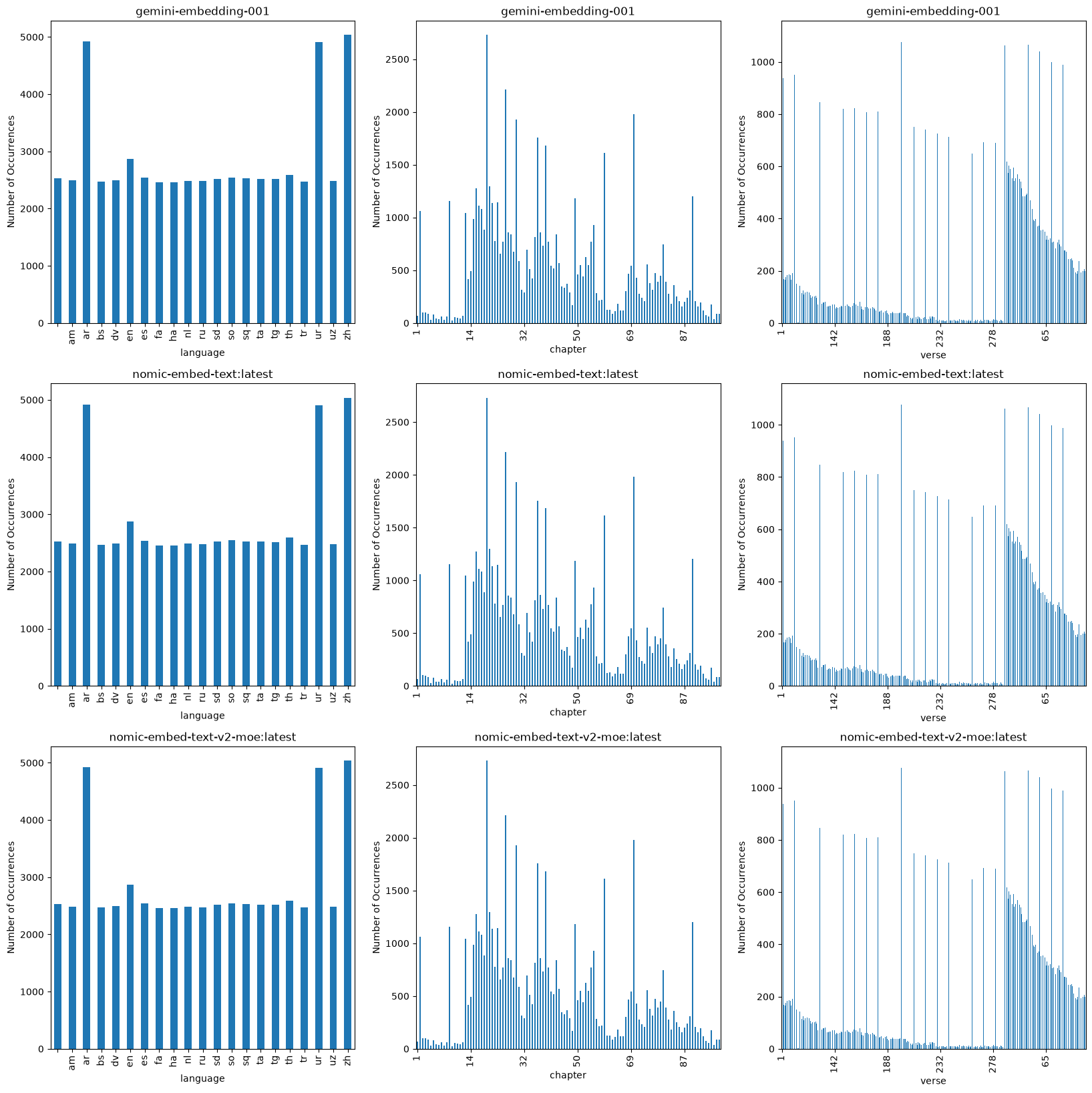
The figure below compares the three samples. Each row of the figure corresponds to a model’s sample, and the columns show the number of records per language (left), per chapter (middle) and per verse number (right). The three rows are identical, as expected, because they contain the same records. The sampling step also checks that the record ids match one for one. The figure that that the samples have identical statistical signature.
Code
fig, ax = plt.subplots(3,3,figsize=(20,20), sharex=False)ax = ax.flatten()for x,c inzip([0, 3, 6],collections.keys()): samples[c].groupby('language').size().plot.bar(ax=ax[x]) ax[x].set_title(c)for x,c inzip([1,4,7],collections.keys()): samples[c].groupby('chapter').size().plot.bar(ax=ax[x]) ax[x].xaxis.set_major_locator(ticker.MaxNLocator(nbins=6)) ax[x].set_title(c)for x,c inzip([2,5,8],collections.keys()): samples[c].groupby('verse').size().plot.bar(ax=ax[x]) ax[x].xaxis.set_major_locator(ticker.MaxNLocator(nbins=6)) ax[x].set_title(c)for a in ax: a.set_ylabel("Number of Occurrences")
Code
for col in samples:if collections[col]!=None: samples[col]['language_description'] = samples[col]['language'].map(language_map)
Code
counts = {}for c in samples:if collections[c] !=None: count = samples[c].fillna('n/a').groupby(['language','language_description'],dropna=False).size() counts[c] = count
The table below gives the number of records per language in each model’s sample after downsampling. English drops from 42,337 records to 2,872, close to the average of the other languages, so no single language dominates the results. Arabic, Urdu and Chinese still have about twice as many records as most other languages. The counts are identical for all three models.
For each sample record, its top-\(k\) nearest neighbours are retrieved from the whole collection (excluding the record itself). A neighbour is a hit if it is the same chapter and verse from a different translation. Precision@k is the fraction of the \(k\) neighbours that are hits.
Because the metric depends only on the ranking of neighbours and not on raw cosine scores, it is comparable across models whose similarity scores are scaled differently.
Hits are further split into same-language hits (e.g. another English translation of the verse) and cross-language hits (e.g. the Arabic for an English query). A model that mostly encodes language rather than meaning can only score same-language hits; cross-language hits require capturing the meaning of the verse.
Mean Reciprocal Rank (MRR)
For each query it takes \(\frac{1}{\text{rank}}\) of the first hit (1.0 if the nearest neighbour is a hit, 0.5 if it is second, etc), averaged over queries. While precision@k rewards finding many translations of the verse; MRR rewards finding one quickly, which is what matters for a semantic search that shows the top result. Only the top 20 neighbours are retrieved, so a query with no hit in its top 20 scores 0 (i.e. this is MRR@20). MRR is also split by language: the rank of the first same-language hit and the rank of the first cross-language hit.
Code
def query_nearest_neighbours(collection, samp, vector, k=20, batch_size=64):"""Retrieve the top-k nearest neighbours of each sample record (excluding the record itself), with no payload filter or score threshold, one row per (query, neighbour).""" rows = []for start inrange(0, len(samp), batch_size): query_ids = samp['id'].iloc[start:start + batch_size].tolist() requests = [ models.QueryRequest( query=vector[start + j].tolist(),filter=models.Filter(must_not=[models.HasIdCondition(has_id=[query_id])]), limit=k, with_payload=["chapter", "verse", "name", "language"], )for j, query_id inenumerate(query_ids) ] results = qdrant_client.query_batch_points(collection_name=collection, requests=requests) rows.extend( {"query_id": query_id, "rank": rank, "id": point.id, "score": point.score, **point.payload}for query_id, res inzip(query_ids, results)for rank, point inenumerate(res.points, start=1) )return pd.DataFrame(rows)
Code
def label_hits(neighbours, samp):"""Join each neighbour to its query record and label it as a hit (same chapter and verse from a different translation), split into same-language and cross-language hits.""" query = samp[['id', 'chapter', 'verse', 'name', 'language']].add_prefix('query_') df = neighbours.merge(query, on='query_id')# chapter/verse are compared as strings since the payload stores them inconsistently is_hit = ( df['chapter'].astype(str).eq(df['query_chapter'].astype(str))& df['verse'].astype(str).eq(df['query_verse'].astype(str))& df['name'].ne(df['query_name']) ) same_language = df['language'].eq(df['query_language'])return df.assign(hit=is_hit, same_language=is_hit & same_language, cross_language=is_hit &~same_language)def precision_at_k(hits, ks):"""Per-query precision@k for each k in `ks`, split into same-language and cross-language hits.""" per_k = [ hits[hits['rank'].le(k)] .groupby('query_id')[['same_language', 'cross_language']] .sum() .div(k) .assign(k=k)for k in ks ] res = pd.concat(per_k).reset_index()return res.assign(precision=res['same_language'] + res['cross_language'])def reciprocal_rank(hits):"""Per-query reciprocal rank of the first hit (0 if none was retrieved), overall and for the first same-language and first cross-language hit.""" first_rank = { col: hits[hits[col]].groupby('query_id')['rank'].min()for col in ['hit', 'same_language', 'cross_language'] }return ( (1/ pd.DataFrame(first_rank)) .reindex(hits['query_id'].unique()) .fillna(0) .rename(columns={'hit': 'rr', 'same_language': 'rr_same_language', 'cross_language': 'rr_cross_language'}) .rename_axis('query_id') .reset_index() )
Code
ks = [1, 5, 10, 20]hits = { key: label_hits( query_nearest_neighbours(collections[key], samples[key], vectors[key], k=max(ks)), samples[key], )for key in samples}query_languages = ( samples[init][['id', 'language_description']] .rename(columns={'id': 'query_id'}) .fillna({'language_description': 'n/a'}))precision = pd.concat(precision_at_k(h, ks).assign(model=key) for key, h in hits.items()).merge(query_languages, on='query_id')mrr = pd.concat(reciprocal_rank(h).assign(model=key) for key, h in hits.items()).merge(query_languages, on='query_id')
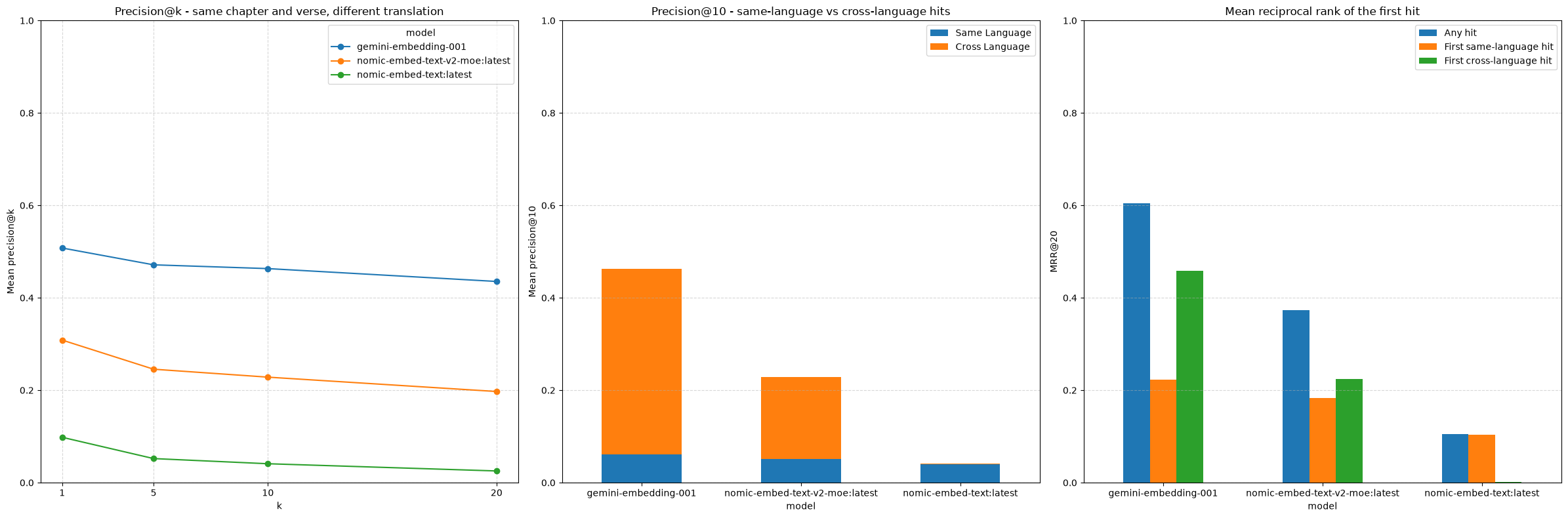
The table below shows the mean precision@k for each model at k = 1, 5, 10 and 20. Precision is the share of the top k neighbours that are another translation of the query verse. It is the sum of Same Language (translations in the query’s language) and Cross Language (translations in other languages). In all tables in this section, the colour scale runs from 0 (pale) to 1 (dark green).
gemini-embedding-001 scores highest at every k, followed by nomic-embed-text-v2-moe:latest and nomic-embed-text:latest. Most of Gemini’s hits are cross-language.
The table below shows the mean reciprocal rank (MRR) of the first hit for each model. MRR (Any Hit) uses the first hit of either kind; the other two columns use the first same-language hit and the first cross-language hit. A value of 1 means the first hit is always the nearest neighbour; lower values mean it tends to appear further down the list, and a query with no hit in its top 20 scores 0.
The ranking matches precision@k. gemini-embedding-001 has the highest MRR and finds a cross-language hit much sooner than the other models. nomic-embed-text:latest almost never finds a cross-language hit in its top 20.
Left: mean precision@k against k. Precision falls slightly as k grows for every model.
Middle: precision@10 split into same-language (blue) and cross-language (orange) hits. Cross-language hits make up most of the precision of gemini-embedding-001 and nomic-embed-text-v2-moe:latest, but almost none of nomic-embed-text:latest.
Right: MRR for any hit (blue), the first same-language hit (orange) and the first cross-language hit (green). The green bar for nomic-embed-text:latest is close to zero: it almost never finds the same verse in another language.
Code
fig, ax = plt.subplots(1, 3, figsize=(24, 8))summary['Precision'].unstack('model').plot.line(ax=ax[0], marker="o")ax[0].set_xticks(ks)ax[0].set_xlabel("k")ax[0].set_ylabel("Mean precision@k")ax[0].set_ylim(0, 1)ax[0].grid(True, linestyle="--", alpha=0.5)ax[0].set_title("Precision@k - same chapter and verse, different translation")k_split =10summary.xs(k_split, level='k')[['Same Language', 'Cross Language']].plot.bar(ax=ax[1], stacked=True, rot=0)ax[1].set_ylabel(f"Mean precision@{k_split}")ax[1].set_ylim(0, 1)ax[1].grid(True, axis="y", linestyle="--", alpha=0.5)ax[1].set_title(f"Precision@{k_split} - same-language vs cross-language hits")mrr_summary.plot.bar(ax=ax[2], rot=0)ax[2].legend(["Any hit", "First same-language hit", "First cross-language hit"])ax[2].set_ylabel("MRR@20")ax[2].set_ylim(0, 1)ax[2].grid(True, axis="y", linestyle="--", alpha=0.5)ax[2].set_title("Mean reciprocal rank of the first hit")plt.tight_layout()
The table below breaks precision@10 (left three columns) and MRR (right three columns) down by the language of the query verse, to show where each model succeeds or fails:
gemini-embedding-001 is the strongest model for most languages. It is far ahead of the other two on Arabic (precision@10 of 0.545 vs 0.073 for nomic-embed-text-v2-moe:latest), Persian, Tajik, Uzbek, Sindhi, Divehi and Amharic.
nomic-embed-text-v2-moe:latest beats Gemini on Bosnian (0.502 vs 0.384) and Albanian (0.316 vs 0.267), and comes close on Spanish and Turkish. It scores close to zero on Tajik, Uzbek, Divehi, Amharic and Sindhi.
nomic-embed-text:latest scores well only on English (0.694). Its MRR for Chinese (0.581) and Urdu (0.175) comes entirely from finding another translation in the same language, since it finds almost no cross-language hits.
All three models score poorly on Hausa and Somali (precision@10 of 0.053 or below). These are considered low resource language with relatively very little NLP corpora.
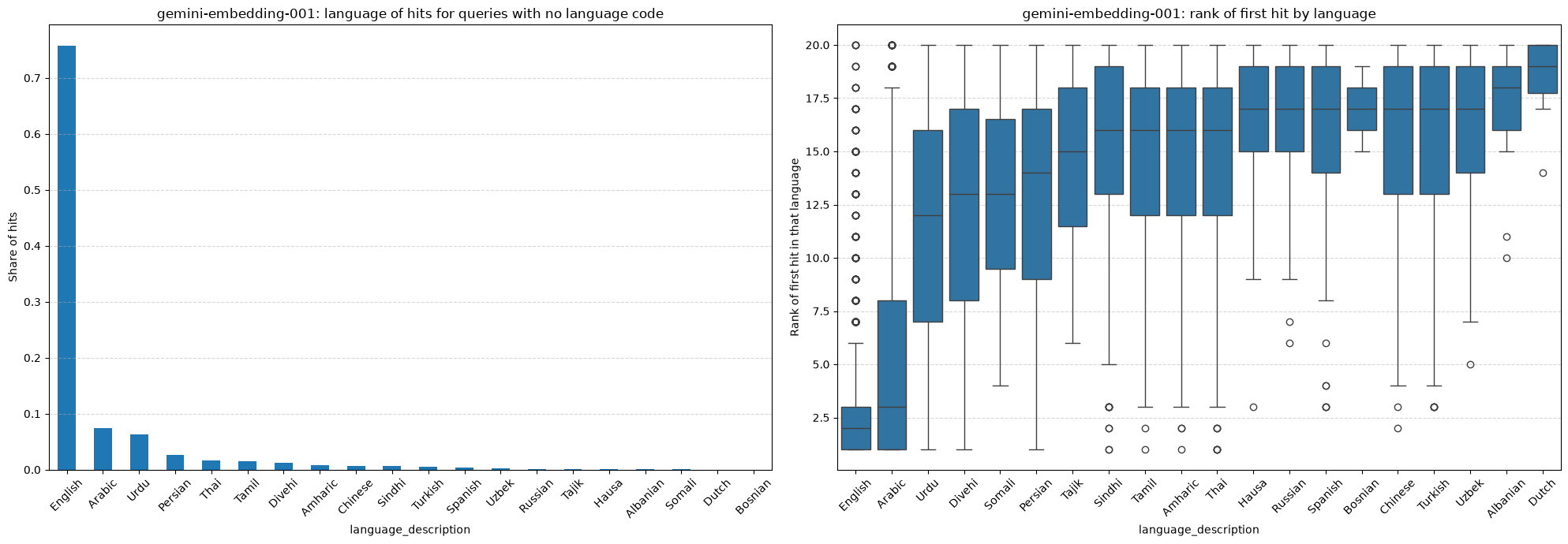
The n/a row (records with no language code) scores 0.730 with Gemini but close to zero with both nomic models. As shown in Appendix A.1 these come from uthmani text which is in Arabic and are not translations. The top ranking hits matching these text are in English, followed by Arabic.
Horses for courses, revisited: Being good at one task says little about another. The model that good at identifying language (nomic-embed-text:latest) is the worst at capturing meaning across languages. It takes exploration to determine the most suitable models for a given task.
“Supported” is not the same as “works well”: nomic-embed-text-v2-moe:latest lists Arabic, Tajik, Uzbek and Amharic as being supported, yet scores close to zero on them. The average across all languages hides this, so it is worth breaking results down by language.
The low resource curse: providing AI solutions to demographies with scarse NLP corpora can be challenging.
4.1 What Next
It is worth exploring how well models specifically tailored to Hausa and Somali perform on the semantic search task discussed in this paper.
Appendix
A.1 Language of the hits for records with no language code (gemini-embedding-001)
The sampled texts above with a blank language code are all in Arabic script and are likely to come from quran-uthmani-arabic.txt, the original Arabic text of the Quran: its filename does not follow the <language>.<translator>.txt pattern, so no language code is parsed from it. The cells below check this by running the script-based detector from lang_util on these records, then break down gemini-embedding-001’s hits for these queries by the language and translation of the hit.
Code
no_lang = samples[init][samples[init]['language'].eq("")]# Translator name(s) and detected language of the records with no language codepd.concat( {'name': no_lang['name'].value_counts(),'detected language': no_lang['text'].map(lambda t: detect_language(t, return_scores=False)['main_language']).value_counts(), })
name                     2527
detected language  ar    2527
Name: count, dtype: int64
The figure below shows the share of gemini-embedding-001’s hits for the no-language queries that fall in each language (left) and the rank of the first hit of each language (right). If these records are the original Arabic, most hits should be the Arabic (ar) tafsirs (Jalalayn and Muyassar) and should appear near the top of the neighbour list.
Code
fig, ax = plt.subplots(1, 2, figsize=(20, 7))hit_language.groupby('language_description')['share_of_hits'].sum().sort_values(ascending=False).plot.bar(ax=ax[0], rot=45)ax[0].set_ylabel("Share of hits")ax[0].set_title(f"{init}: language of hits for queries with no language code")ax[0].grid(True, axis="y", linestyle="--", alpha=0.5)first_hit_rank = ( no_lang_hits .assign(language_description=no_lang_hits['language'].map(language_map).fillna('n/a')) .groupby(['query_id', 'language_description'])['rank'].min() .reset_index())order = first_hit_rank.groupby('language_description')['rank'].median().sort_values().indexsb.boxplot(data=first_hit_rank, x='language_description', y='rank', order=order, ax=ax[1])ax[1].tick_params(axis='x', rotation=45)ax[1].set_xlabel("language_description")ax[1].set_ylabel("Rank of first hit in that language")ax[1].set_title(f"{init}: rank of first hit by language")ax[1].grid(True, axis="y", linestyle="--", alpha=0.5)plt.tight_layout()